The global appetite for Makhana is growing at an estimated 22% CAGR as of 2026, with export volumes from Bihar reaching record highs. But the commercial opportunity is accessible only to exporters who have fully resolved the compliance picture. A single documentation gap — an absent APEDA certificate, a mis-classified HS code, an expired FSSAI licence — can result in border rejection, shipment destruction at importer cost, and market blacklisting that can take years to reverse.
This guide is written for serious exporters, importers, and procurement teams. It does not offer cursory overviews; it provides the actual regulatory framework, the specific documentation required, the common failure points, and the strategic decisions that separate professional export operators from those learning by trial and rejection.
Step Zero: HS Code Classification
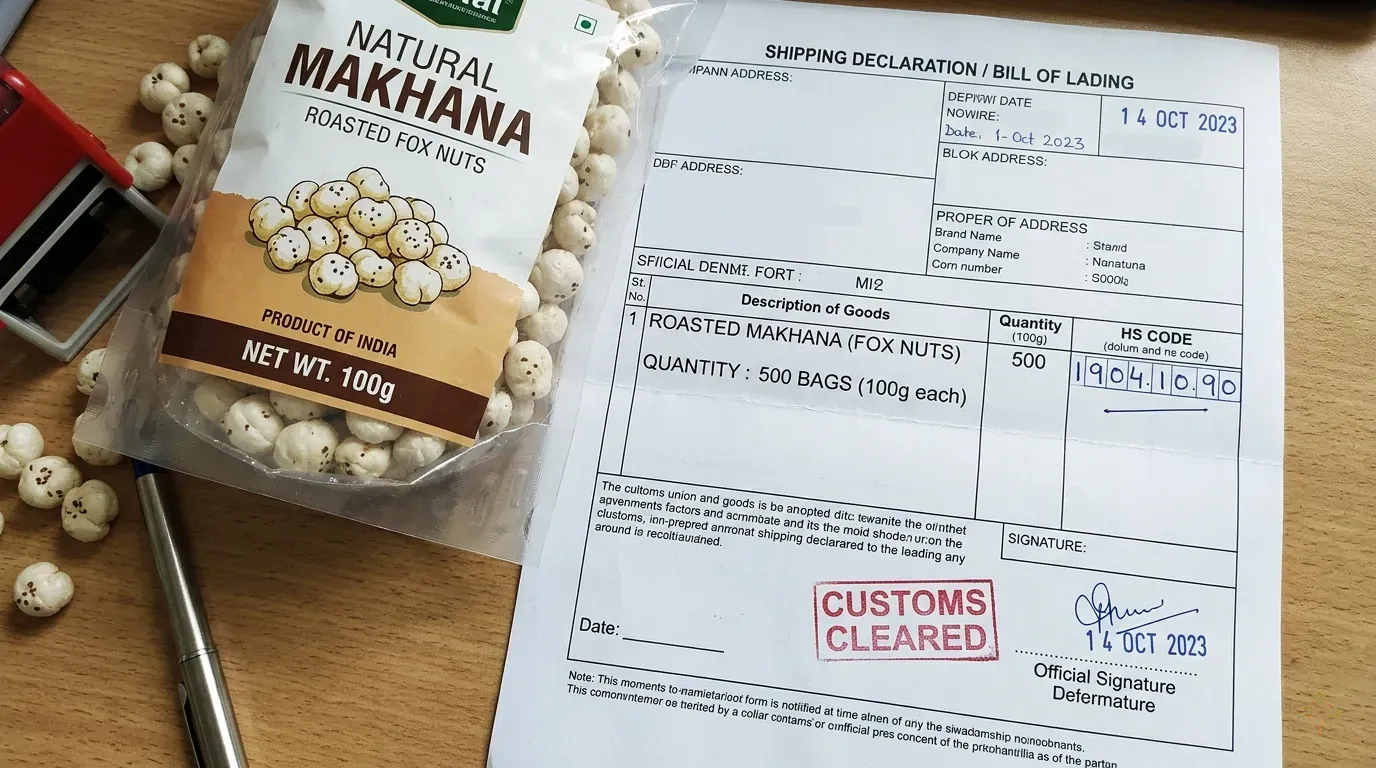
Before any certification or documentation process begins, Makhana must be correctly classified under the Harmonised System (HS) code framework. Mis-classification is one of the leading causes of customs delays and border rejections for Makhana shipments, because the product does not fit neatly into conventional food categories.
The correct HS code for puffed Makhana (the dominant commercial form) is 1106.30 — "Flour, meal and powder of the dried leguminous vegetables of heading 0713" — or more commonly 0713.39 for dried seeds. Some destination markets classify it under 2008.99 (other prepared or preserved fruits, nuts, and other edible parts of plants). The classification used determines:
- The applicable import duty rate in the destination country
- Which food safety regulations apply (novel food, conventional food, or supplement)
- Required labelling categories (ingredient declaration, nutrition labelling format)
- Whether phytosanitary certificates are required alongside food safety documentation
Critical: HS code classification should be confirmed with both Indian Customs (using the Indian HS schedule) and a customs broker in the destination country before first shipment. Quantyra Labs routinely assists import partners with bilateral HS code confirmation as part of our pre-shipment service.
Indian Domestic Compliance: FSSAI and APEDA
FSSAI Export Certification
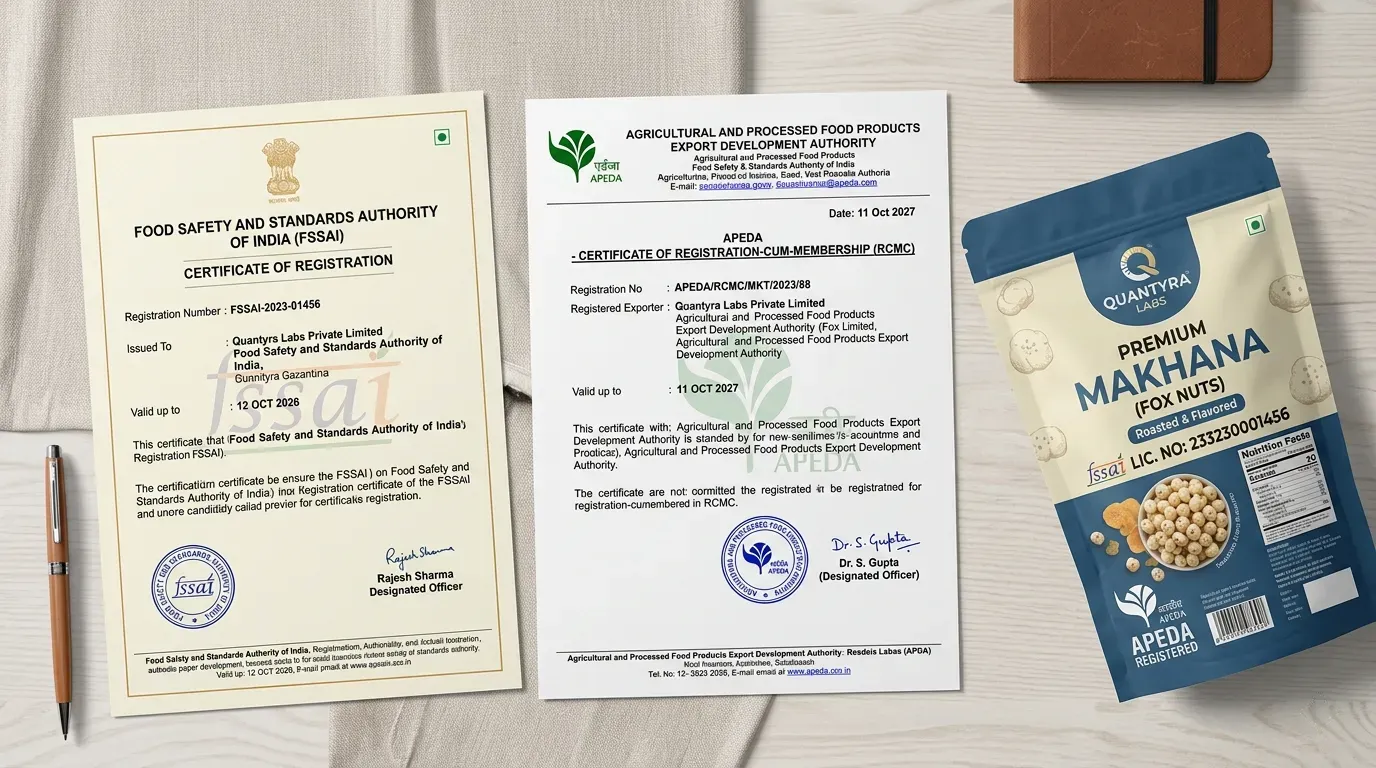
The Food Safety and Standards Authority of India (FSSAI) is the primary food regulatory body in India. Any entity manufacturing, processing, or exporting food products from India must hold a valid FSSAI licence — distinct from the basic FSSAI registration applicable to small retailers. For export, the relevant licence tier is Central FSSAI Licence, which covers businesses with a turnover above ₹20 lakh or those engaged in import/export operations.
For Makhana specifically, exporters must ensure the FSSAI licence covers the following operations as listed:
- Processing of cereals and cereal products (or, depending on classification, dried seeds)
- Sorting, grading, and packing of food commodities for export
- Storage facilities (if relevant to the export model)
FSSAI also issues Export Health Certificates (EHC) for specific destination markets that require them — notably the EU, which has historically required EHCs for organic products and certain processed foods. While Makhana as a conventional product does not uniformly require an EHC, organic-certified Makhana destined for EU markets does.
APEDA Registration
The Agricultural & Processed Food Products Export Development Authority (APEDA) manages export promotion and regulation for a specified list of agri and processed food products. Makhana (Fox Nuts) falls under APEDA's export schedule, meaning that exporters require APEDA registration and must comply with APEDA's quality and packaging guidelines.
APEDA registration provides exporters access to several beneficial programmes:
- APEDA-approved laboratory empanelment for testing reports recognised by importing countries
- Market development assistance (MDA) scheme — financial reimbursement for participation in international food trade fairs
- Packaging development assistance for export-oriented packaging redesign
- e-Cert platform for electronic certificate-of-origin issuance
GI Tag Documentation
For Mithila Makhana specifically, exporters sourcing from GI-registered farms should obtain the GI Use Agreement from the Geographical Indications Registry in Chennai, and maintain Farm-level traceability documentation (farm registration certificates issued by the GI Authorised User network in Bihar). This documentation increasingly commands a premium in European and North American markets where provenance verification is expected by sophisticated buyers.
European Union: The Most Demanding Framework
The EU represents Makhana's fastest-growing premium export destination, but also its most complex regulatory environment. Exporters must navigate three overlapping frameworks: General Food Law, Novel Food Regulation, and the EU's country-specific import conditions for food from India.
Novel Food Status: The Critical Question
EU Regulation 2015/2283 on novel foods requires that any food not consumed "to a significant degree" within the EU before 15 May 1997 must receive authorisation before being placed on the market. Makhana's novel food status in the EU is currently a nuanced legal question that exporters must resolve before attempting significant commercial volumes.
As of 2026, Makhana has a documented history of consumption in some EU member states within Indian diaspora communities, particularly in the United Kingdom (pre-Brexit), Germany, the Netherlands, and Belgium. The European Food Safety Authority (EFSA) is the body that evaluates novel food applications, and a dossier submission requires substantial evidence including:
- Compositional data (full nutritional analysis including micronutrients and bioactive compounds)
- Proposed specifications for the food/ingredient
- History of use in third countries (India's documented multi-century consumption history)
- Proposed uses and use levels in the EU market
- A toxicological dossier if relevant bioactive compound concentrations raise questions
Quantyra Labs works with a Brussels-based regulatory consultancy to track the status of Makhana's novel food application. Importers are advised to seek specific legal advice before listing Makhana in EU retail, as the position may evolve. We provide up-to-date regulatory briefings to all partners upon request.
EU Food Safety Requirements
All Makhana destined for EU markets must comply with:
- EC 1881/2006 — Maximum levels for contaminants (aflatoxins, heavy metals, dioxins)
- EC 396/2005 — Maximum residue levels (MRLs) for pesticides. The EU applies default MRLs of 0.01 mg/kg for pesticides not specifically listed — extremely stringent
- EC 1169/2011 — Food information to consumers (labelling requirements)
- Regulation 852/2004 — General hygiene requirements for food businesses
Organic Certification for EU Premium Market Access
For Makhana destined for EU organic retail — which commands a 40–60% premium over conventional — the applicable regulation is EU Regulation 2018/848 (the Organic Regulation). Indian organic certification accepted under the EU's equivalence framework must be issued by an NPOP (National Programme for Organic Production) approved certification body. The importer must also carry out full chain-of-custody documentation from farm to EU border.
United States: FDA and FSVP
FSMA and the Foreign Supplier Verification Programme
Since the implementation of the US Food Safety Modernization Act (FSMA), US importers of food products are subject to the Foreign Supplier Verification Programme (FSVP) under 21 CFR Part 1, Subpart L. This regulation shifts significant compliance responsibility to the US importer, who must:
- Conduct a hazard analysis for Makhana as imported
- Verify that the foreign supplier (the Indian exporter) is producing food in accordance with US food safety standards
- Maintain records demonstrating supplier verification activities
- Conduct and document periodic on-site audits, or review equivalent third-party audit reports
For Indian Makhana exporters, this means that US import relationships require a level of transparency and documentation previously uncommon in the dried-food trade. Exporters who cannot provide facility audit reports, HACCP plans, and testing records will struggle to establish and maintain US import partnerships with compliance-conscious distributors.
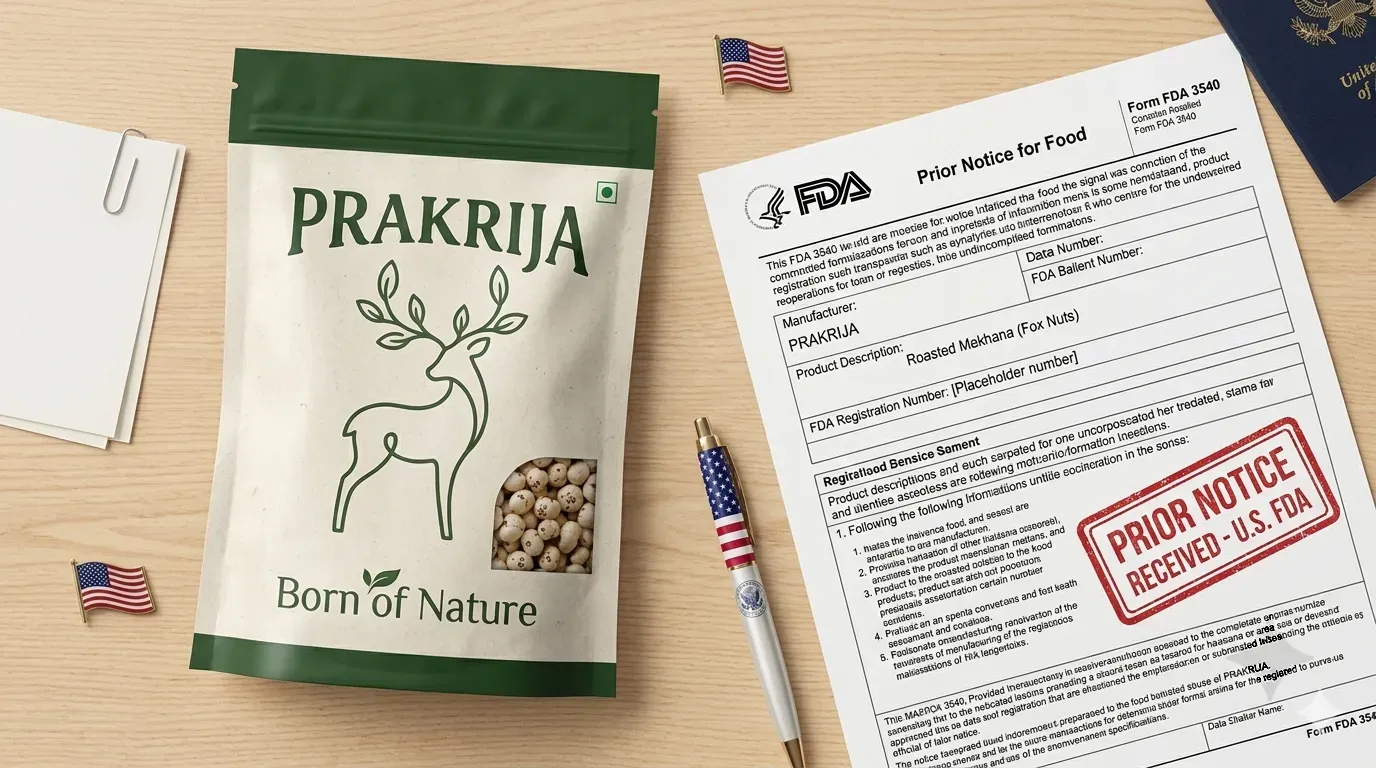
FDA Prior Notice
All food shipments entering the US must be registered with the FDA via Prior Notice at least 2–4 hours before arrival (for sea freight, this extends to 8 hours before arrival at the US port). The Prior Notice must include:
- Full product description and quantity
- Country of origin (India)
- Manufacturer and shipper details (including FDA Facility Registration Number if applicable)
- Anticipated port of entry
- Carrier and arrival date/time
FDA Facility Registration
Indian food processing facilities exporting to the US must be registered with the FDA under Section 415 of the Federal Food, Drug, and Cosmetic Act. Registration must be renewed biennially during the October–December window. Failure to maintain registration results in mandatory border refusal of all shipments from the unregistered facility.
Labelling Requirements (US)
US labelling for Makhana must comply with 21 CFR Part 101. Key requirements distinct from EU/Indian standards include:
- Nutrition Facts panel in the specific US format (updated format required since 2020, including added sugars declaration)
- Serving size must reflect current US reference amounts (RACC)
- Ingredient declaration in descending order by weight
- "Country of Origin" labelling (COOL) — "Product of India" required
- Net weight in both metric (g) and US customary (oz) units
- Contact information for a US responsible party (the US importer serves this role)
GCC Markets: Halal Certification and Gulf Standards
The Gulf Cooperation Council (GCC) — comprising UAE, Saudi Arabia, Qatar, Bahrain, Kuwait, and Oman — is a significant and fast-growing Makhana destination, driven by the large South Asian diaspora and rising health food consciousness. Compliance requirements focus on two primary areas: Halal certification and GSO (Gulf Standards Organisation) conformity.
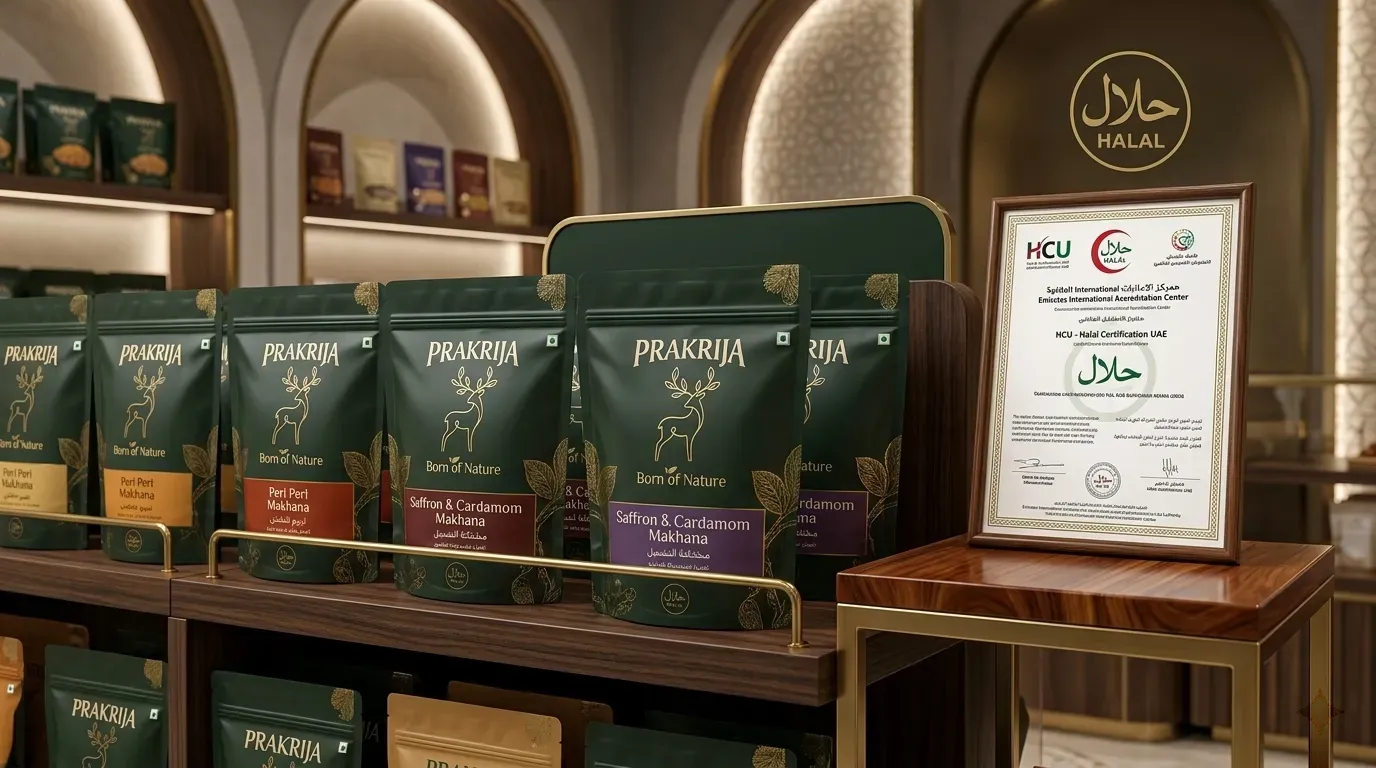
Halal Certification
While Makhana is inherently plant-based and free from haram (prohibited) ingredients, Halal certification remains a mandatory commercial and increasingly regulatory requirement for food sold in GCC retail. The applicable certification bodies accepted by GCC authorities include:
- Halal India (accredited by the Islamic Chamber of Commerce)
- JAKIM (Malaysia) — widely accepted across GCC
- MUI (Indonesia) — accepted in UAE and Saudi Arabia
- IFANCA (USA) — accepted for premium positioning
Saudi Arabia additionally requires that Halal certificates be issued by bodies on the Saudi Food and Drug Authority's (SFDA) approved list — which is updated periodically. UAE's Emirates Authority for Standardization & Metrology (ESMA) maintains its own approved Halal body list.
GSO Technical Regulations
The Gulf Standards Organisation (GSO) issues technical regulations applicable across GCC member states. For food products, key GSO standards include labelling (GSO 9:2013), date marking, and general food safety requirements. Arabic language labelling is mandatory in all GCC states — the label must include the product name, ingredient list, allergen declaration, net weight, country of origin, manufacturer name and address, and expiry date, all in Arabic.
Australia and New Zealand: FSANZ Framework
Food Standards Australia New Zealand (FSANZ) administers the Australia New Zealand Food Standards Code, which governs food imported into and sold in both countries. For Makhana, the key compliance considerations are:
- Novel Food Assessment: Similar to the EU, FSANZ requires that new food substances not previously approved be assessed under Standard 1.1.1 (Novel Food). Makhana has a claim to pre-approval use in Australia given Indian community consumption, but formal clearance should be confirmed with a regulatory consultant before retail launch.
- Biosecurity Act (2015) Import Conditions: Makhana is classified under BICON (Biosecurity Import Conditions system) — importers must check the current conditions, which may include heat treatment requirements or documentation of origin region.
- Country of Origin Labelling: Australia requires "Product of India" declarations in a specific format under the Australia New Zealand Food Standards Code.
Market-by-Market Compliance Summary
- Novel Food status — legal review required (Amber)
- EU Pesticide MRL compliance — strict 0.01 mg/kg default
- Aflatoxin testing mandatory (max 4 μg/kg)
- FSSAI EHC for organic; standard COA for conventional
- EU-format nutrition declaration mandatory
- Organic: NPOP certification + EU chain of custody
- FDA Facility Registration (biennial renewal)
- Prior Notice — 2–8 hrs before arrival
- FSVP compliance — importer-side obligation
- HACCP plan required from exporter
- US Nutrition Facts panel format required
- COOL "Product of India" declaration
- Halal certification — ESMA-approved body required for UAE
- Arabic language labelling mandatory
- GSO conformity for general food safety
- SFDA-specific requirements for Saudi Arabia
- Certificate of origin (Chamber of Commerce attested)
- Health certificate from Indian authority
- Novel food status check required (FSANZ)
- BICON biosecurity import conditions
- Mandatory country of origin label (AU format)
- APEDA certification recognised
- Allergen declaration — AU/NZ specific format
- Importer must hold applicable business licences
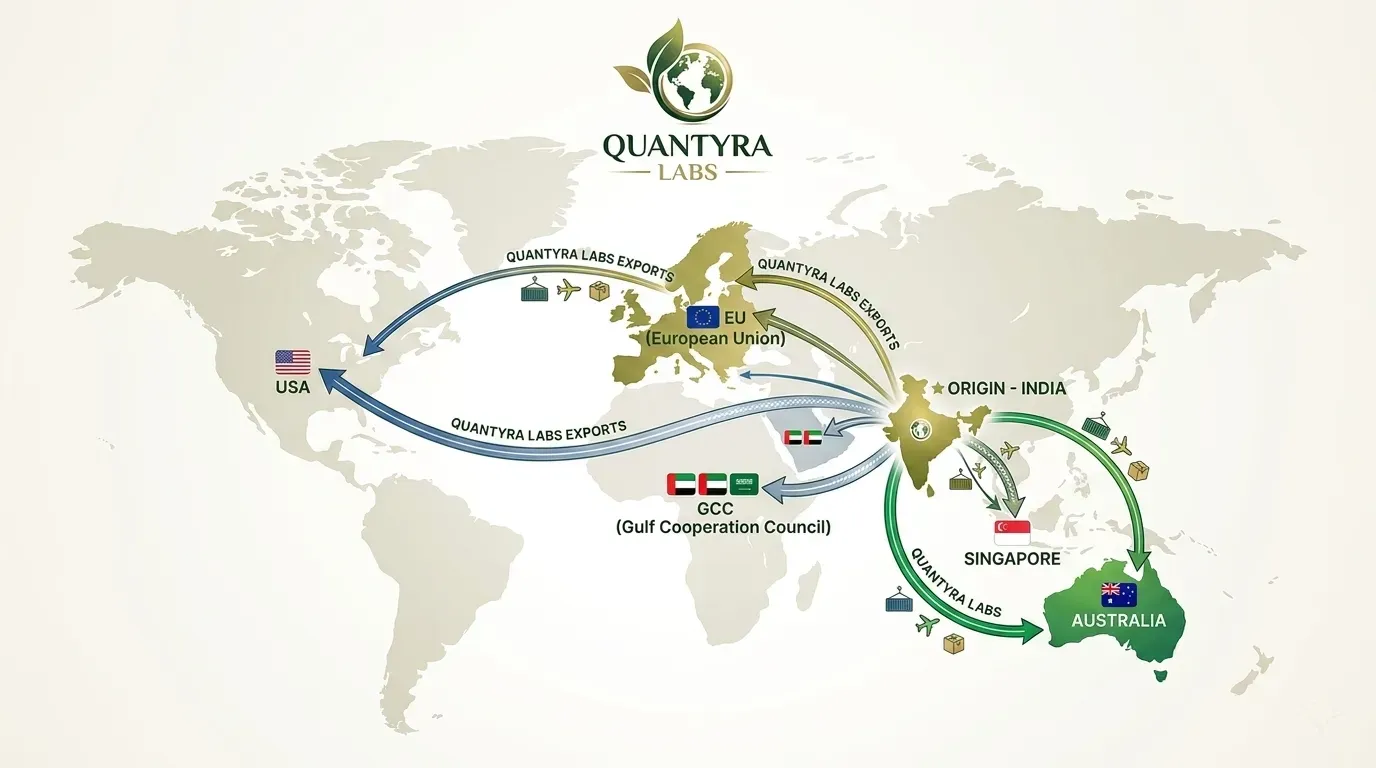
The Master Documentation Checklist
The following documents are required for a compliant Makhana export shipment. The precise subset required varies by destination market — but maintaining readiness across the full list is best practice for exporters serving multiple markets simultaneously.
| Document | EU | USA | GCC | Australia |
|---|---|---|---|---|
| FSSAI Licence (Central) | Required | Required | Required | Required |
| APEDA Registration Certificate | Required | Required | Required | Required |
| Certificate of Origin (Attested) | Required | Required | Required | Required |
| NABL Lab COA (Full Panel) | Required | Required | Recommended | Required |
| Phytosanitary Certificate | Market-specific | Required | Required | Required |
| Halal Certificate | Not required | Not required | Required | Not required |
| FDA Prior Notice | Not applicable | Required | Not applicable | Not applicable |
| EU Export Health Certificate | Organic only | Not applicable | Not applicable | Not applicable |
| HACCP / Food Safety Plan | Required | Required (FSVP) | Recommended | Required |
| GI Use Certificate (Mithila) | Recommended | Recommended | Recommended | Recommended |
Labelling: The Often-Underestimated Compliance Layer
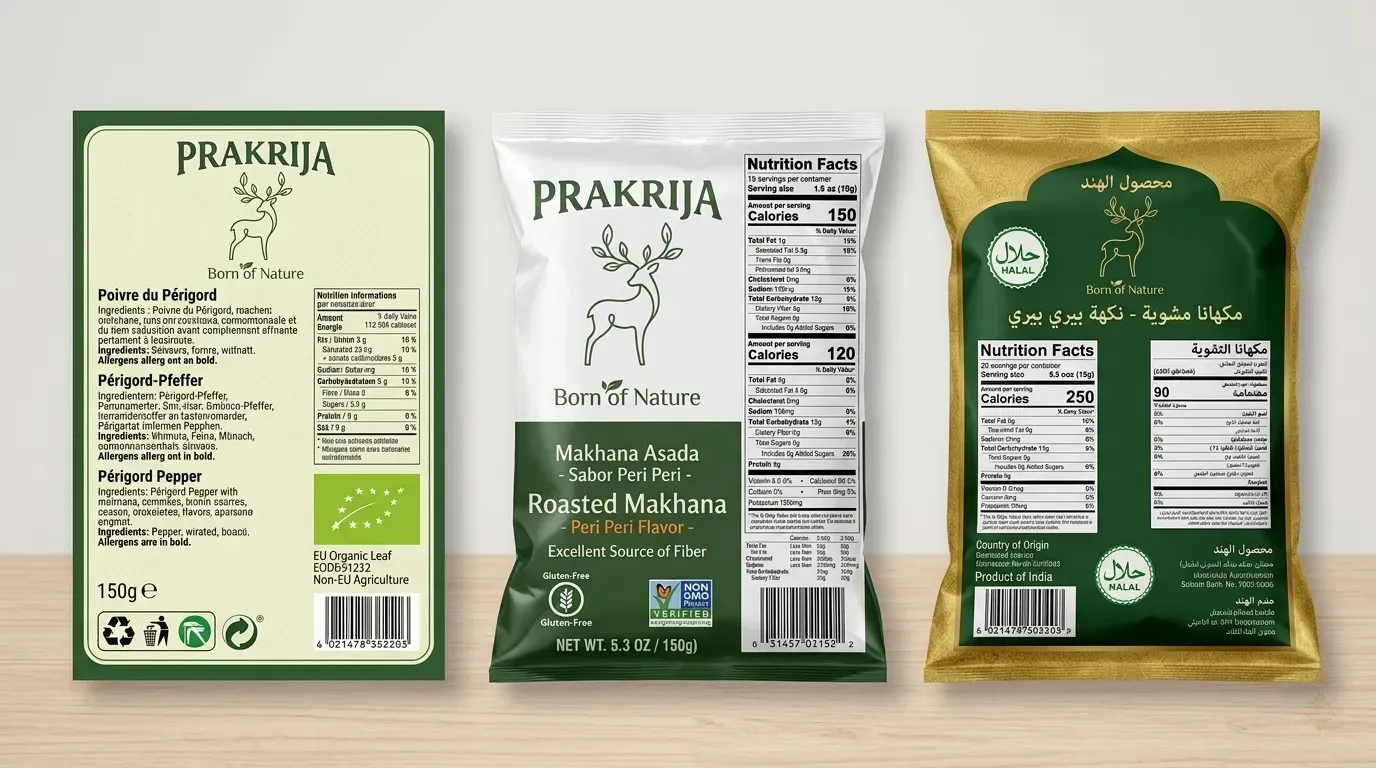
Labelling compliance is among the most common reasons for border rejection of Makhana shipments, and the errors are frequently elementary — wrong allergen declaration format, missing date marking, or a nutrition panel in EU format on a US-destined shipment. The following table captures the key labelling divergences:
| Labelling Element | India (FSSAI) | EU | USA | GCC |
|---|---|---|---|---|
| Nutrition declaration | Per 100g, per serving | Per 100g mandatory; per portion optional | Per serving (RACC-based) | Per 100g or per portion |
| Language requirement | English + one Indian language | Official language(s) of member state | English | Arabic mandatory |
| Date marking format | DD/MM/YYYY | "Best before" or "Use by" — EU format | Month Day, Year | DD/MM/YYYY, Hijri optional |
| Allergen declaration | FSSAI Schedule XI | EU 14 allergens in bold | FDA Top 9 (sesame added 2023) | GSO format |
| Added sugars | Not mandated separately | Not mandated separately | Mandatory declaration | Not mandated separately |
Common Export Failure Points and How to Avoid Them
Based on Quantyra Labs' experience managing over 180 Makhana export shipments across 14 destination countries, the following failure categories account for approximately 85% of documented compliance incidents:
- Aflatoxin Exceedances — Makhana stored in humid conditions, particularly during the Indian monsoon season, is susceptible to aflatoxin B1 contamination. EU and US limits are stringent (4 μg/kg and 20 μg/kg respectively for aflatoxin total). Mitigation: maintain moisture below 12% through silica-gel desiccant packaging, and test every batch — not every supplier.
- Pesticide Residue Violations — India's domestic pesticide MRLs are significantly more permissive than EU defaults. Product that passes FSSAI standards may still violate EU pesticide MRLs. Mitigation: test to EU MRL standards prior to shipment, specifically using a multi-residue panel covering at minimum 200 compounds.
- APEDA Certificate Expiry — APEDA registration must be renewed annually. A lapsed APEDA certificate will result in clearance delays and potential border rejection. Mitigation: calendar renewal 60 days before expiry.
- Labelling Non-Conformance — Destination-specific label errors (wrong panel format, missing language, incorrect allergen declaration). Mitigation: use market-specific label templates reviewed by a local regulatory consultant before first shipment.
- HS Code Mis-classification — Using the wrong HS code results in incorrect duty assessment, potential classification as a "controlled" item in some markets, and customs hold. Mitigation: obtain a binding tariff classification ruling from the destination country's customs authority before first shipment.
"Compliance is not a cost centre — it is the price of market access. Every shipment rejected at a border costs 5–10x the price of the compliance programme that would have prevented it."
— Arjun Sinha, Export Compliance Lead, Quantyra Labs

How Quantyra Labs Manages Compliance End-to-End
Quantyra Labs was built, from inception, as a compliance-first export operation. Every process element is designed to ensure that our import partners receive not just product, but a defensible compliance record for every shipment.