What Exactly is Makhana?
Makhana (pronounced mak-haa-naa) is the popped, roasted seed of the Euryale ferox plant — a large aquatic herb that grows in the still waters of ponds, lakes, and wetlands across South and East Asia. In English, these seeds are commonly called Fox Nuts or Lotus Seeds, though Euryale ferox is botanically distinct from true lotus (Nelumbo nucifera). The confusion is understandable — both plants are large-leafed aquatic species with similar habitats — but they belong to entirely different genera.
The seeds are harvested from spiny, golf ball-sized fruits that form beneath the water's surface. Raw, these seeds are hard and unpalatable. To become the light, crunchy, puffed snack you recognise as Makhana, they undergo a traditional processing technique: pan-roasting at high heat causes the starchy interior to expand, bursting through the seed coat to produce the characteristic white, spherical puff. It is this puffed form — not the raw seed — that is consumed and traded globally.
Botanical Identity: Euryale ferox
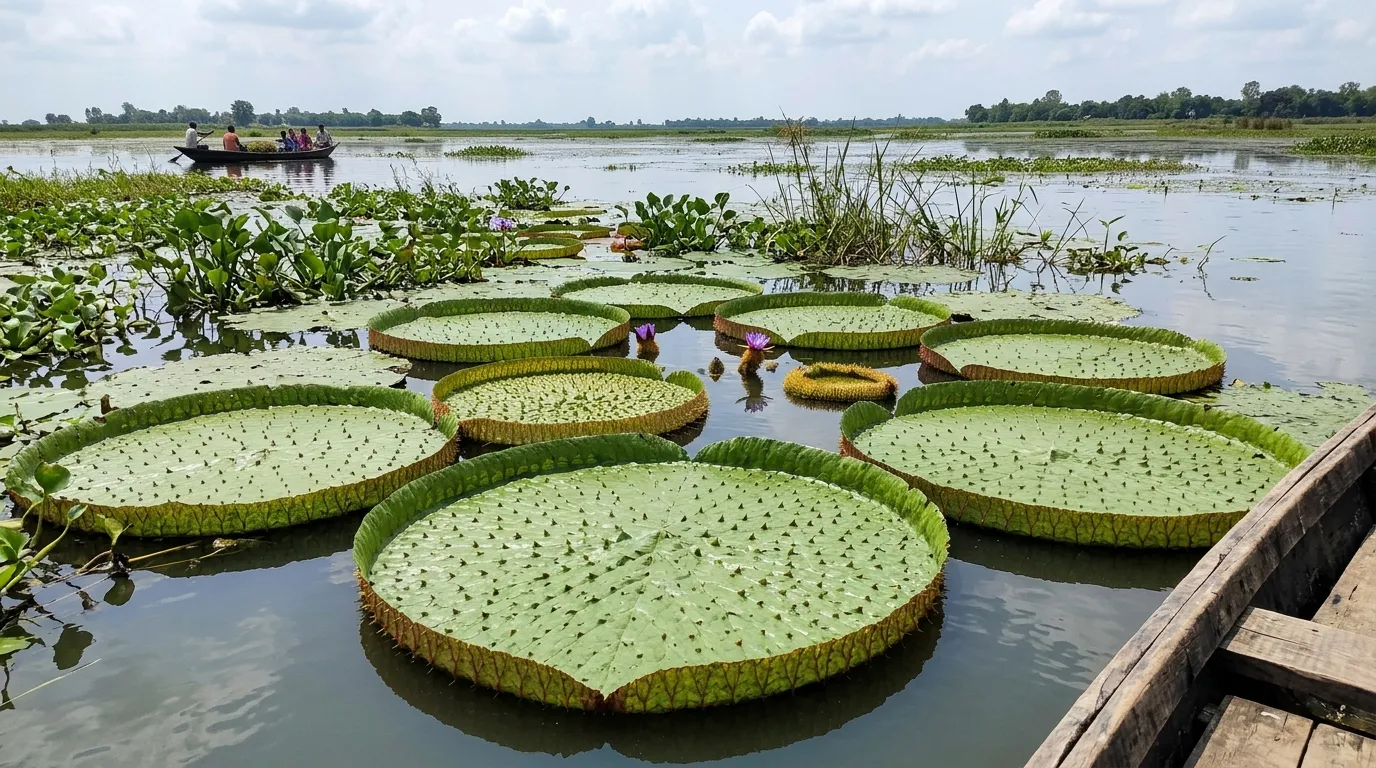
Euryale ferox Salisbury is the sole species in the genus Euryale, family Nymphaeaceae (the water lily family). It is an annual herb characterised by enormous floating leaves — often exceeding 1.5 metres in diameter — that are deep green on top, purple beneath, and covered in prominent veins and spines. The underside of the leaf and the stems bristle with sharp, needle-like thorns that deter grazing animals, giving rise to the English name "Prickly Water Lily."
The flowers are small, purple, and self-pollinating, producing submerged berries roughly the size of a golf ball. Each fruit contains between 10 and 20 seeds encased in a dark, starchy aril. It is these seeds — cleaned, dried, and processed — that become Makhana.
"Euryale ferox is not merely a plant — it is a living economic system for the wetland communities of Mithila, supporting an estimated 500,000 farming households whose livelihoods are built around a single aquatic species."
NABARD Agricultural Survey, 2024Origin and Geography: Why Bihar Dominates
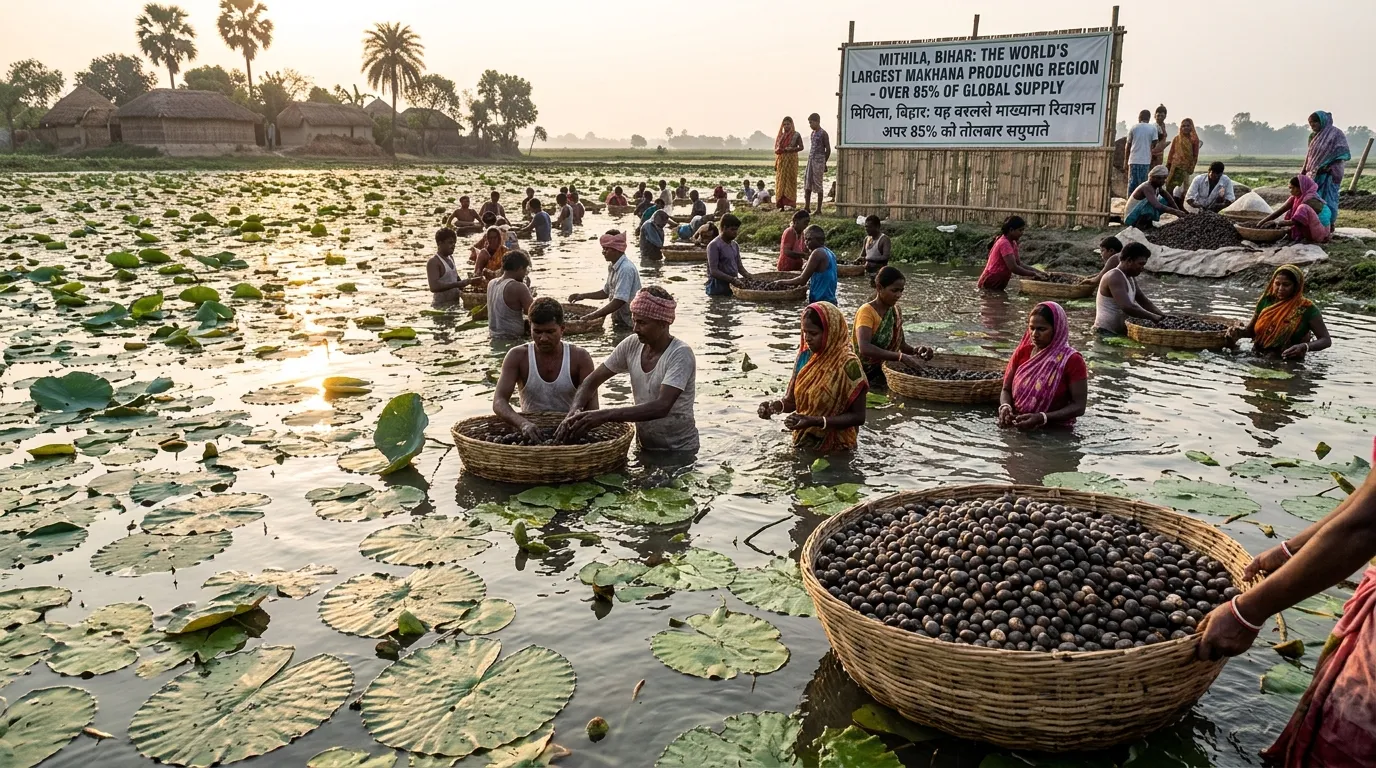
Makhana cultivation is almost entirely concentrated in Mithila — the historical region of Bihar in northeastern India — for reasons that are both ecological and cultural. The seasonal floodplains, shallow seasonal ponds (chaurs), and slow-moving wetlands of this region provide the still, warm, nutrient-rich water that Euryale ferox requires. Temperatures between 25°C and 35°C, combined with high humidity and organic-rich sediment, create conditions that are difficult to replicate elsewhere at scale.
Bihar's Darbhanga, Madhubani, Sitamarhi, Supaul, and Saharsa districts together account for the vast majority of India's — and therefore the world's — Makhana output. China produces smaller quantities in Jiangxi and Hunan provinces under the name qiànshí, but Indian production dwarfs Chinese output both in volume and in the development of processing infrastructure.
In 2022, Mithila Makhana was granted a Geographical Indication (GI) Tag by the Government of India — the same protection that covers Darjeeling Tea and Champagne. This means that only Makhana grown in the defined Mithila region can legally be marketed under that designation, providing a meaningful quality and origin guarantee for importers.
How Makhana is Made: From Pond to Puff
The production of Makhana is almost entirely manual and involves a sequence of skilled steps passed down through the Mallah fishing communities of Bihar. Each stage has a direct bearing on the quality of the final product.
Farmers wade chest-deep into ponds to collect the spiny fruits by hand or with long-handled rakes. Harvesting occurs from September to November as the plant completes its seasonal cycle.
Fruits are cracked open and seeds washed thoroughly to remove the fleshy aril. Seeds are then sun-dried for 3–5 days to reduce moisture to below 12% — critical for shelf stability.
Dried seeds are sorted into three commercial grades: Lava (large, premium export grade), Sutta (medium), and Thurri (small, used for flour). Grade significantly affects yield, texture, and price.
Seeds are roasted in heavy iron pans at ~250°C. Expert workers — trained over years — strike the seeds with a wooden mallet at precisely the right moment to produce the characteristic white puff. Mistimed strikes result in breakage or incomplete popping.
The entire process — from pond to packaged puff — typically takes 10–14 days and involves five to eight distinct manual operations. This labour intensity is one reason why premium Makhana commands a significant price premium over conventional snacks, and why mechanised production has struggled to replicate the sensory quality of hand-processed product.
Nutritional Profile: The Basics
Makhana's commercial rise is not purely marketing. The nutritional credentials are substantive enough to withstand scrutiny. Per 100g of plain, roasted Makhana:
| Nutrient | Amount (per 100g) | Notable Comparison |
|---|---|---|
| Energy | 347 kcal | Lower than most nuts |
| Protein | 9.7g | Higher than popcorn (3.7g) |
| Carbohydrate | 76.9g | Low GI despite high carbs |
| Dietary Fibre | 7.6g | Comparable to oats |
| Total Fat | 0.1g | Exceptionally low |
| Calcium | 56mg | Useful plant-based source |
| Magnesium | 67mg | ~16% of daily requirement |
| Potassium | 1,368mg | Exceptional — 3x a banana |
| Phosphorus | 200mg | Supports bone health |
| Iron | 1.4mg | Bioavailability moderate |
| Sodium | 1mg | Virtually nil — heart-friendly |
| Glycaemic Index | ~35 | Low (under 55 = low GI) |
The key nutritional story is the combination of very low fat, meaningful protein, low glycaemic index, and exceptional potassium content. No single nutrient makes Makhana exceptional — it is the aggregate profile that justifies the superfood label. Critically, these figures apply to plain, roasted Makhana. Flavoured variants with added oils, salt, or sugar can materially alter the profile.
Traditional Uses: Ayurveda, Fasting Foods, and Festive Cuisine
Makhana occupies a unique position in Indian food culture that extends well beyond nutrition. In Ayurveda, it is classified as a Satvik food — the highest quality category — and prescribed for kidney health, reproductive vitality, bone strengthening, and as a cooling food during summer. Classical texts including the Charaka Samhita and Ashtanga Hridayam document Makhana's therapeutic applications in detail.
In Hindu fasting tradition, Makhana is one of a small number of foods permitted during major fasts (Navratri, Ekadashi, Mahashivaratri), alongside fruits, dairy, and specific flours. This fasting-food status ensures consistent demand spikes aligned with India's religious calendar — a market dynamic with no parallel in Western snack food categories.
In festive and ceremonial cooking, Makhana features in kheer (a slow-cooked milk pudding), makhana curry cooked in rich gravies, and roasted trail mixes offered at religious ceremonies and weddings. This deep cultural embedding is a critical competitive moat — it is not a trend food that can be displaced by the next superfood cycle.
Market Context: Where Makhana Sits in 2026
The global Makhana market was valued at approximately USD 38 million in 2024 and is projected to grow at 8–11% CAGR through 2030, driven primarily by export demand from the United States, United Kingdom, UAE, Canada, and Australia — markets with significant South Asian diaspora populations and a broader mainstream interest in low-GI, plant-based snacking.
India's Makhana exports have grown significantly following the 2022 GI tag, which provided exporters a clearer quality narrative and regulatory legitimacy in premium markets. APEDA-registered exporters now access a growing roster of health food retailers, direct-to-consumer channels, and food service accounts in target markets.
Common Misconceptions Worth Correcting
- Makhana is a lotus seed — Partially accurate. Euryale ferox is related to the lotus family but is a distinct species. True lotus seeds from Nelumbo nucifera are also consumed but are nutritionally and texturally different.
- All Makhana is the same — It is not. Grade (Lava vs Sutta vs Thurri), processing method, moisture content, and origin (GI-tagged Mithila vs non-tagged sources) produce meaningfully different quality outcomes.
- The flavoured versions are just as healthy — Frequently incorrect. Masala, caramel, and cheese-flavoured Makhana products often contain added refined oils, high sodium, and sugar that substantially alter the nutritional case.
- Makhana has no quality standards — FSSAI has established standards for moisture, aflatoxin levels, and purity for traded Makhana; APEDA regulates export quality certification. GI-tagged product carries additional provenance documentation.
Conclusion
Makhana is, in aggregate, one of the most nutritionally well-positioned traditional foods to find a global audience in the current health-conscious market environment. It offers a combination of low fat, low sodium, low GI, reasonable protein, and a genuine 3,000-year track record of human use — attributes that few snack foods can honestly claim simultaneously.
Understanding what Makhana actually is — botanically, culturally, nutritionally, and commercially — is the foundation for evaluating every subsequent claim made about it. The subsequent guides in this series address its specific health benefits, comparison with competing snacks, and its implications for particular health conditions.